
◷ Reading Time: 8 minutes
In this example, we will explain how you can create an entire project by loading a DMN file into FlexRule Designer. This DMN file is for the direct car insurance claim settlement decisions.
Scenario
In Belgium, car insurance companies adhered to the RDR (Rapid Dispute Resolution) convention to make settling car accident damages simpler. It’s like an agreement between these companies to make the claim process smoother. In this setup, the insurance companies of the people involved in an accident directly handle the damages without bothering the insured individuals. While joining the RDR convention is optional for insurance companies, most in Belgium have chosen to be part of it. So, if you have comprehensive car insurance with one of these companies, they’ll use the RDR convention to settle your claims if you’re in a qualifying car accident.
Mainly there are two sections associated with this process.
- Determine RDR Clearing Eligibility
- Determine Accident Liability
Determine RDR Clearing Eligibility
In order to eligible for the RDR settlement, certain criteria has to be met by both parties:
- Where? Accident should occur in Belgium.
- Who? Both drivers hold active comprehensive insurance with company .
- What? Only two cars were involved, no bodily injuries.
- Proof? Signed European Accident Statement with clear liability based on checkboxes.
To determine RDR Clearing Eligibility, two decisions will be involved:
- Counterparty Object RDR Eligibility
- Car Accident RDR Eligibility
Counterparty Object RDR Eligibility
This decision involves deciding whether the counterparty is eligible for the RDR settlement. In order to do that we need some additional information about the counterparty like RDR Affiliated Companies list. Then the input counterparty details will be checked against that list.

And also Motor vehicle type will be considered.

Then, those two decisions will be considered against the Counterparty Vehicle Country of Registration, Counterparty Vehicle Insurance Obligation, and Counterparty Vehicle Insurance Status. As the final outcome of this stage “Counerparty Object RDR Eligibility” will be determined.

Car Accident RDR Eligibility
Car Accident RDR Eligibility will be determined based on information related o the car accident.

RDR Clearing Eligibility
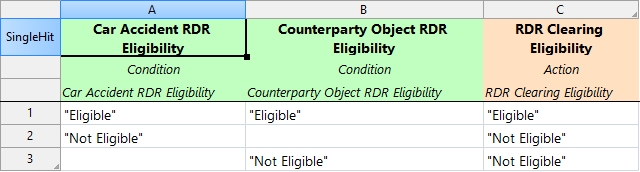
Then, those two decision outcomes(Car Accident RDR Eligibility and Counterparty Object RDR Eligibility ) will be the input for the RDR Clearing Eligibility Decision Table, as follows.
The overall RDR Clearing Eligibility decision can be represented in a DRD as follows.

Determine Car Accident Liability
This Decision combines with two sub-decisions.
- Insured and counterparty accident circumstances
- Circumstances Enrichment
Insured and Counterparty Accident Circumstances
Insured and counterparty accident circumstances will be evaluated to determine car accident liability.
Since multiple input circumstances are possible, it needs to be iterated using the FEEL expression, which considers one circumstance at a time to determine its gravity.

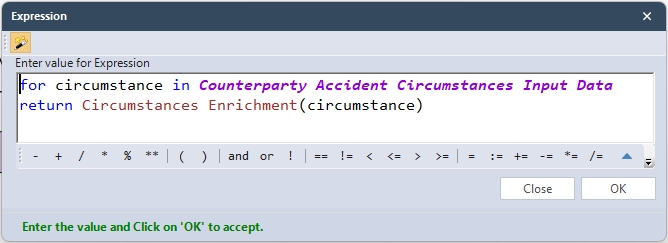
This FEEL expression calls the Business Knowledge node, which is linked with a Decision Table called Circumstances Enrichment, and passes a single circumstance at a time. And also, the return of these two FEEL expressions is saved in two separate parameters. (Insured Customer Accident Circumstances, Counterparty Accident Circumstances)
Circumstances Enrichment
The following Decision Table called “Circumstances Enrichment” is used to determine the gravity of each input circumstance.

This Decision Table will be called in both insured and counterparty accident circumstances. And then results (Gravity and Circumstance) will be added to Insured Customer Accident Circumstances, Counterparty Accident Circumstances.
These two( Insured and counterparty accident circumstances ) sub decisions will be the input to the Car Accident Liability decision(describe later in this article) as follows.

Car Accident Liability
This decision is modelled as a Boxed Expression with following Boxed Invocations
- Insured Customer Number Of Circumstances : count of Insured Customer Accident Circumstances
- Counterparty Number Of Circumstances : count of Counterparty Accident Circumstances
- Insured Customer Accident Circumstance
- Counterparty Accident Circumstance
- Insured Customer Highest Circumstance Gravity
- Counterparty Highest Circumstance Gravity
- Circumstance Gravity Liability

At the last Boxed Invocation,, the output value will be saved in the parameter Car Accident Liability. That will be an input for the next and final Decision node, which is RDR Car Accident Position.
Once the RDR Clearing Eligibility and Car Accident Liability is determined, RDR Car Accident Position can be determined as follows. This will be the outcome of the RDR claim settlement.

Overall Decision Requirements Diagram will be as follows:

How to Create this Project
To create this project, you can use the FlexRule Designer built-in feature “From DMN File” at the home screen and locate the attached DMN file with this project. IT will automatically load this entire project from the given DMN file and be ready to test and deploy without any modification.
How to Run the Project
Additionally, we included 4 sample inputs as Logic Run Templates in the main Decision Requirements Diagram(DRG.xml) inside the folder called “Diagrams”.

Video Description
Download
Use the attachment at the end of the page to download the sample project as well as the DMN file.